From 0 to 8 Sales in 72 Hours: Rapid Creative Testing for a THC Gummies Brand
How we validated a cannabis offer quickly using AI-assisted creative editing, high-trust ad infrastructure, and conversion-focused tracking.
Running paid ads for cannabis products is not straightforward.
Between platform restrictions, ad account instability, creative limitations, and weak conversion feedback, most THC campaigns struggle before they even get enough data to optimize.
For this campaign, the goal was not to scale aggressively from day one. The goal was simple:
Validate the offer quickly, identify what type of creative could convert, and build a data foundation for the next scaling phase.
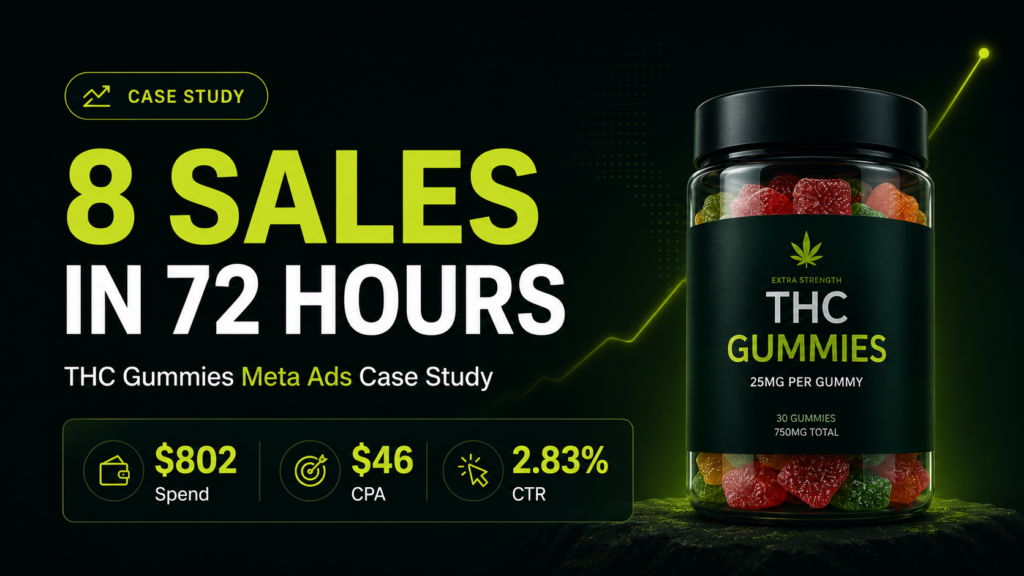
Within five days, we tested 20 creatives, moved from zero sales to confirmed purchases, and brought the most recent CPA down to $46.
Campaign Snapshot
Niche: Cannabis / THC Gummies
Campaign Duration: 5 Days
Total Spend: $802
Sales: 8
Average Order Value: $80
CTR: 2.83%
CPC: $2.42
CPM Range: $38–$68
Initial CPA: $126
Most Recent CPA: $46
The key result:
8 sales generated within 72 hours of finding the right creative direction.
The Challenge
THC gummies sit in one of the most difficult categories to advertise.
Even when the offer is strong, the campaign still has to deal with:
- Restricted product category
- Higher account risk
- Limited room for direct product claims
- Expensive traffic
- Difficulty passing clean conversion data back to Meta
- Fast creative fatigue
- Unclear early signals if the campaign is not structured properly
Most campaigns in this category fail because they move too slowly.
They test a few creatives, wait too long, receive poor data, and then assume the offer does not work.
We approached this differently.
Instead of waiting weeks to “see what happens,” we built this as a rapid creative testing sprint.
Our Strategy
1. Move Fast: 20 Creatives Tested in 5 Days
Speed was the biggest advantage in this campaign.
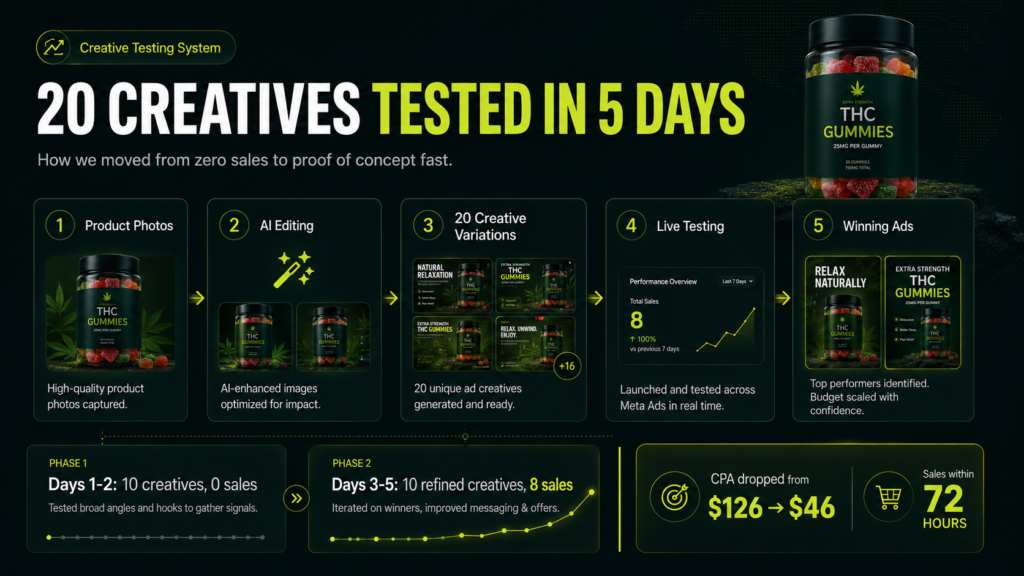
We did not rely on one or two static ads and hope they worked. We created and tested 20 different creatives in five days.
But these were not generic AI-generated creatives.
We started with the actual product assets and used AI-assisted editing to quickly turn those product visuals into multiple ad variations.
This allowed us to create a wide range of brand-aligned creatives without needing a full production shoot for every angle.
The creative testing process included:
- Product-focused visuals
- Lifestyle-inspired product edits
- Different headline treatments
- Multiple layouts
- Different color and contrast treatments
- Offer-led variations
- Cleaner, more premium product presentation
- Scroll-stopping edits built around the actual gummy product
This gave us speed without losing relevance.
The product still looked real. The creatives still matched the brand. But we were able to produce and test variations much faster than a traditional design workflow.
2. Strong Ad Account Infrastructure
In restricted niches, creative strategy alone is not enough.
A campaign can have great ads, a strong product, and a solid funnel — but if the ad account cannot survive the testing phase, the campaign dies before it has a chance to optimize.
For this campaign, we used high-trust agency ad account infrastructure designed for difficult categories.
This helped us keep the campaign stable while testing aggressively.
The benefit was simple:
We could focus on creative testing and optimization instead of constantly dealing with account interruptions.
That stability matters a lot when you are testing 20 creatives in a short window.
3. Conversion Tracking Built for Optimization
A major issue with restricted campaigns is that Meta often does not receive useful conversion data.
If the pixel only sees surface-level events or incomplete funnel activity, the algorithm has very little to optimize from.
For this campaign, we used a protected tracking setup that allowed relevant purchase data to be passed back into Meta for optimization.
The goal was not just to track results internally.
The goal was to give Meta enough meaningful conversion data to improve delivery.
This made a big difference.
Once the campaign started receiving better conversion signals, performance improved quickly.
The Campaign Timeline
Days 1–2: Broad Creative Testing
We launched the first batch of creatives to test broad angles and collect early signals.
The first 10 ads did not generate sales.
For many advertisers, this is where the panic starts.
But for us, this was still useful data.
The first phase showed us which angles were not strong enough, which visuals were not creating enough buying intent, and which messages were not connecting with the audience.
This gave us the direction for the next creative batch.
Days 3–5: Refined Creatives Start Converting
The second batch of creatives was built using the early learnings from the first two days.
Instead of continuing with the same approach, we adjusted the creative direction quickly.
The next 10 creatives produced the breakthrough.
Over the next 72 hours, the campaign generated:
8 sales
This gave us the proof of concept we were looking for.
The offer could convert.
The funnel could generate purchases.
The tracking setup was feeding useful data.
The creative direction had started to click.
Performance Improvement
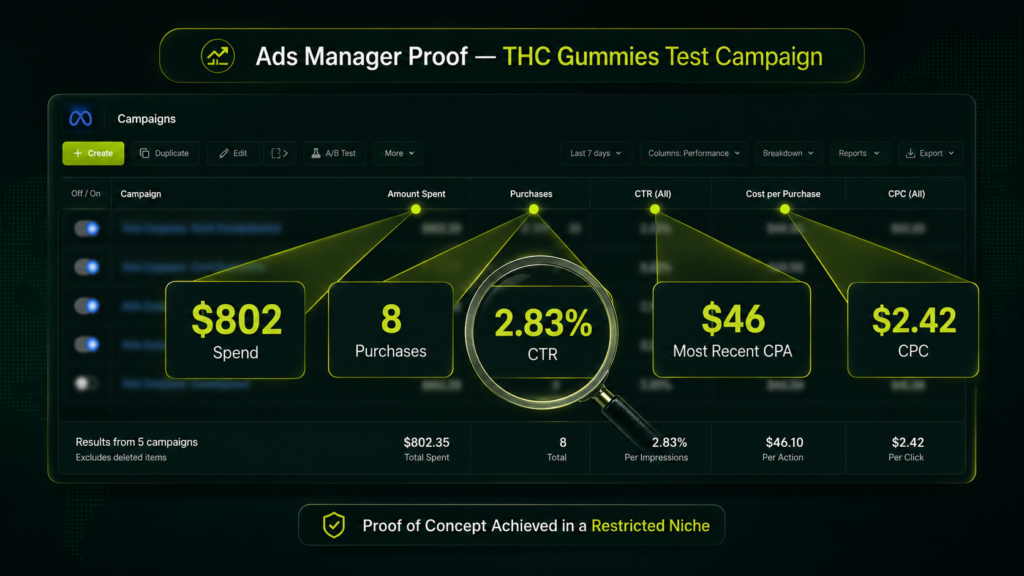
One of the strongest parts of this campaign was the CPA movement.
At the start, the campaign was sitting at an initial CPA of:
$126
After the creative refinement and improved optimization signals, the most recent CPA dropped to:
$46
That is a major improvement in just a few days.
This was not the result of one lucky ad.
It came from fast testing, fast iteration, stable infrastructure, and better conversion feedback.
Key Results
20 Creatives Tested in 5 Days
We quickly moved through multiple creative angles instead of relying on slow, manual production cycles.
8 Sales Generated
The campaign moved from zero sales to confirmed purchases within the testing window.
Sales Within 72 Hours
Once the winning direction was identified, sales came in quickly.
CPA Improved From $126 to $46
The most recent CPA showed a clear improvement after creative refinement and better optimization data.
2.83% CTR
The campaign generated strong engagement for a restricted product category.
$2.42 CPC
Traffic costs remained manageable despite operating in a difficult niche.
What This Campaign Proved
This was not a mature scaling campaign yet.
It was a fast validation campaign.
And that distinction matters.
The goal was to answer a few important questions:
Can this offer generate purchases from paid traffic?
Yes.
Can we produce enough creatives quickly to find a working angle?
Yes.
Can the ad account infrastructure support testing in a restricted category?
Yes.
Can the campaign feed useful data back into Meta for optimization?
Yes.
Is there a clear path toward the next scaling phase?
Yes.
That is exactly what a strong proof-of-concept campaign should do.
Why Speed Matters in Restricted Niches
In categories like cannabis, slow testing is expensive.
The longer it takes to identify winning angles, the more budget gets wasted on assumptions.
Our approach was built around speed:
- Create more usable creative variations quickly
- Launch fast
- Read the data early
- Cut weak angles
- Push the strongest signals
- Improve CPA before scaling
This is how restricted-category campaigns should be tested.
Not with guesswork.
Not with one or two creatives.
Not with slow approvals and unstable accounts.
But with a system designed to move quickly and learn quickly.
What We Would Do Next
After validating the offer, the next stage would be focused on controlled scaling.
The next steps would include:
- Scaling the best-performing creatives
- Creating more variations around the winning angles
- Testing new landing page versions
- Improving bundle offers to increase AOV
- Building retargeting audiences
- Testing lookalike audiences from buyers and engaged visitors
- Expanding budget gradually while monitoring CPA stability
The foundation is now in place.
The campaign has real purchase data, proven creative direction, and an early CPA benchmark to improve from.
Final Takeaway
This campaign shows what is possible when speed, creative testing, infrastructure, and tracking work together.
In just five days, we tested 20 creatives for a THC gummies brand, found a working direction, generated 8 sales, and brought the most recent CPA down to $46.
For a restricted category, that is a strong proof of concept.
The biggest win was not just the revenue.
The biggest win was clarity.
We now know what type of creative can convert, what the early acquisition cost looks like, and how to structure the next phase for scale.
In restricted niches, the brands that win are not always the ones with the biggest budgets. They are the ones that test faster, learn faster, and execute with the right infrastructure.
Ready to See Results Like These?
Let us build a campaign strategy tailored to your restricted niche.