How We Generated $216,163 for a U.S. THC Store Using Meta Ads in a Restricted Niche
A full-stack campaign covering creatives, tracking, ad account stability, and daily optimization — resulting in 2.96x ROAS from $73,000 in ad spend.
Running Meta ads for THC products is not like running ads for a normal e-commerce brand.
You are dealing with a restricted category, strict ad review, limited creative flexibility, approval issues, tracking challenges, and a much smaller margin for error. Even when the product has demand, keeping campaigns stable and profitable over a long period is the real challenge.
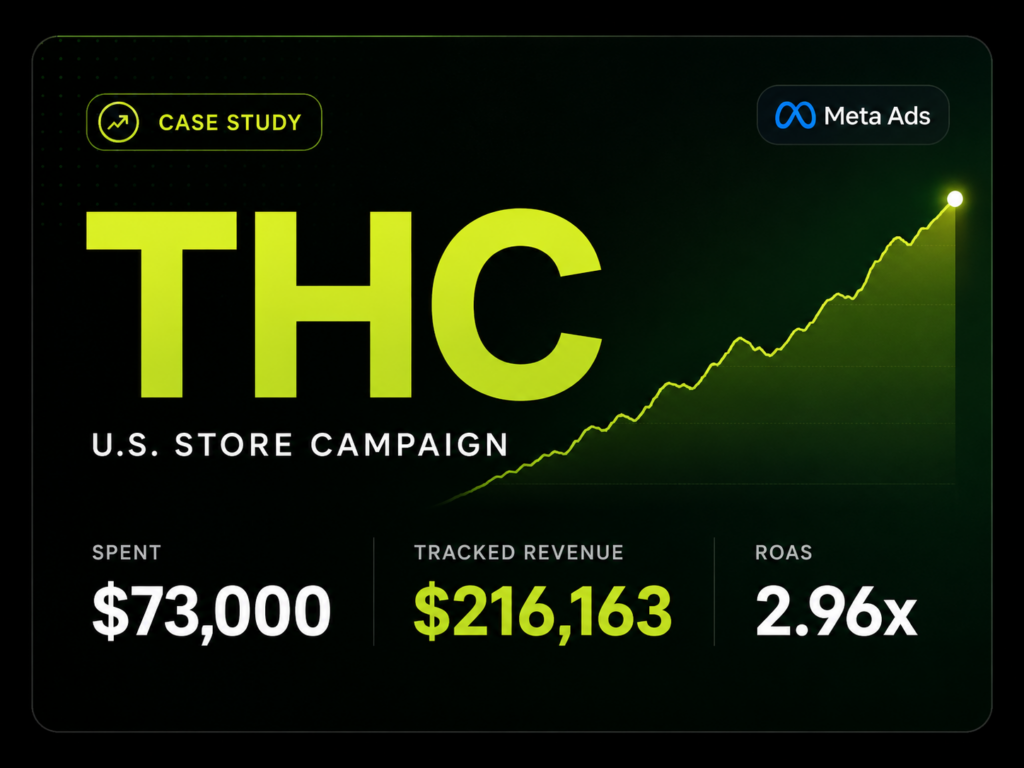
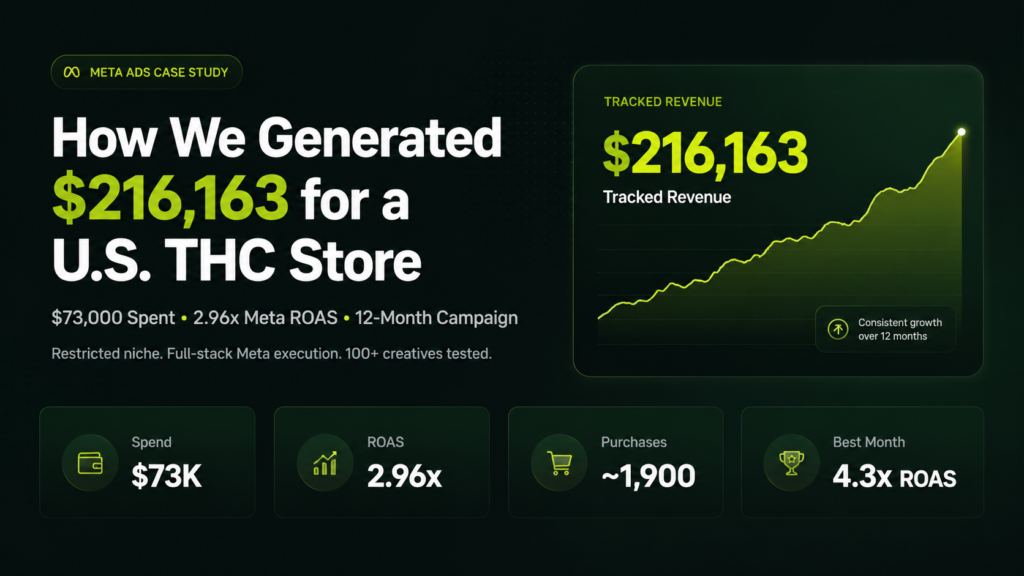
This case study breaks down how we helped a U.S.-based online THC store generate $216,163 in Meta-attributed revenue from $73,000 in ad spend, resulting in a 2.96x ROAS over a 12-month campaign.
The actual revenue was likely higher. Due to tracking gaps during part of the campaign, Meta underreported revenue by at least 20%, meaning the real backend revenue was closer to $259,000+.
Results Snapshot
Niche: Online THC store
Country: United States
Product: Delta-8 / Delta-9 THC gummies
Platform: Meta Ads
Campaign duration: 12 months
Funnel: Ad → Website homepage
Campaign objective: Sales / Purchase
Total ad spend: $73,000
Meta-attributed revenue: $216,163
Estimated actual revenue: $259,000+
Meta-attributed ROAS: 2.96x
Purchases: ~1,900
Average cost per purchase: ~$38
Best month: January 2026
Best month spend: $6,777
Best month revenue: $29,230
Best month ROAS: 4.3x
Creatives tested: 100+
Ad accounts used: 3
The Starting Point
This was not a brand starting from zero.
The client already had organic sales and was already running Meta ads through another agency. The problem was that the campaigns were not profitable enough to scale confidently.
Before we took over, the campaign was averaging around 1.4x ROAS.
For a restricted U.S. THC brand, that was not enough. The product had demand, but the ad system was not strong enough yet. The client needed better tracking, better creative testing, more stable campaign execution, and a media buying setup that could survive the challenges of running in a sensitive category.
Within 3 months, we took over the full advertising operation.
The Main Challenge
The biggest challenge was not whether people wanted the product.
The brand already had buyers. The product already had organic traction. The real challenge was turning Meta into a stable, profitable acquisition channel.
The two biggest issues were:
- Tracking accuracy
Revenue tracking was not always reliable. For part of the campaign, Meta was underreporting revenue, which made optimization harder and made the reported ROAS more conservative than the actual backend performance. - Ad approvals and campaign stability
THC is a restricted category. Creative messaging, product presentation, and campaign structure had to be handled carefully. The campaign needed to sell the product without being overly aggressive or creating unnecessary approval issues.
This required more than basic media buying. It needed full-stack execution across creatives, campaign structure, tracking, account management, and daily optimization.
Our Role
We handled the entire Meta advertising operation except the website and landing pages.
This included:
- Campaign strategy
- Media buying
- Creative direction
- Static ad production
- Copywriting
- Tracking setup and monitoring
- Ad account management
- Approval troubleshooting
- Daily optimization
- Reporting
- Scaling decisions
The client already had the store and product. Our job was to turn Meta into a more profitable and stable acquisition channel.
Campaign Strategy
We kept the campaign focused on what mattered: purchases and revenue.
The campaigns were built manually and optimized for sales from the start. Instead of relying on low-intent objectives, we focused on purchase optimization and structured the campaigns around cold traffic, retargeting, and creative angles.
The structure included:
- Manual sales campaigns
- Purchase optimization
- Broad prospecting
- Retargeting campaigns
- Cold vs retargeting separation
- Creative-angle-based campaign segmentation
- Controlled budget increases for scaling
This gave us enough control to test different angles while still keeping the campaign simple enough to optimize cleanly.
Creative Strategy
Creative was one of the most important parts of the campaign.
In restricted niches, you cannot always say everything directly. The challenge is to communicate the product, the benefit, and the buying reason without making the ad too aggressive for review.
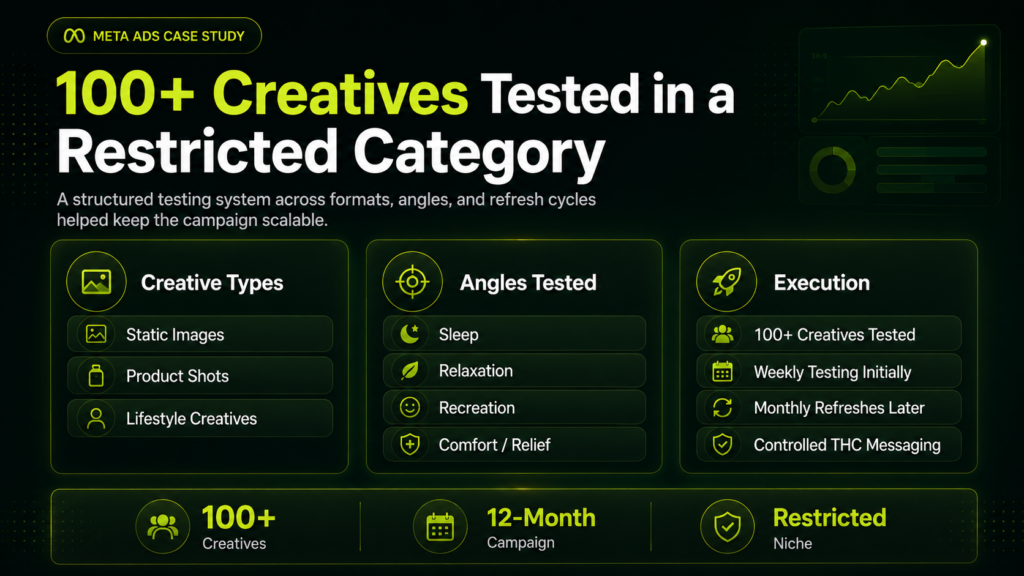
Over the course of the campaign, we tested 100+ creatives across:
- Static images
- Product shots
- Lifestyle creatives
- Subtle benefit-led concepts
- Offer and product-focused visuals
The main angles tested were:
- Sleep
- Relaxation
- Recreation
- Comfort/relief
- Lifestyle use cases
- Product-focused THC gummy creatives
No single angle carried the entire campaign. Sleep, relaxation, recreation, and product-led creatives all performed well. This was actually a positive sign because it gave us multiple creative lanes to scale instead of depending on one fragile winning ad.
In the early stage, we launched new creatives every week. Once the campaign became more stable, we moved to a monthly creative refresh cycle.
Tracking and Attribution
Tracking was one of the biggest areas of improvement.
The campaign revenue reported in this case study is based on Meta-attributed data. However, during part of the campaign, the pixel did not track revenue properly, which caused Meta to underreport actual sales.
Because of that, the numbers in this case study are conservative.
Meta reported:
- $216,163 in revenue
- 2.96x ROAS
But the client’s backend revenue was at least 20% higher during the affected period. Based on that, the actual revenue generated from the campaign was likely $259,000+.
We still use the Meta numbers in this case study because they are the cleanest and most conservative source of attribution.
Optimization Process
Daily optimization focused on keeping the campaign profitable and stable.
The work included:
- Monitoring ad approvals
- Checking campaign health
- Scaling winning creatives
- Cutting weak ads
- Adjusting budgets
- Separating cold and retargeting performance
- Reviewing purchase data
- Refreshing creatives
- Watching for tracking inconsistencies
- Maintaining account stability
Since this was a restricted THC campaign, optimization was not only about ROAS. It was also about continuity.
A normal e-commerce campaign can sometimes survive aggressive testing. In this niche, aggressive changes can create approval issues or account instability. So the campaign had to be scaled carefully.
Across the full 12-month period, we used only 3 ad accounts, which helped keep the campaign stable while still giving us backup infrastructure.
The Results
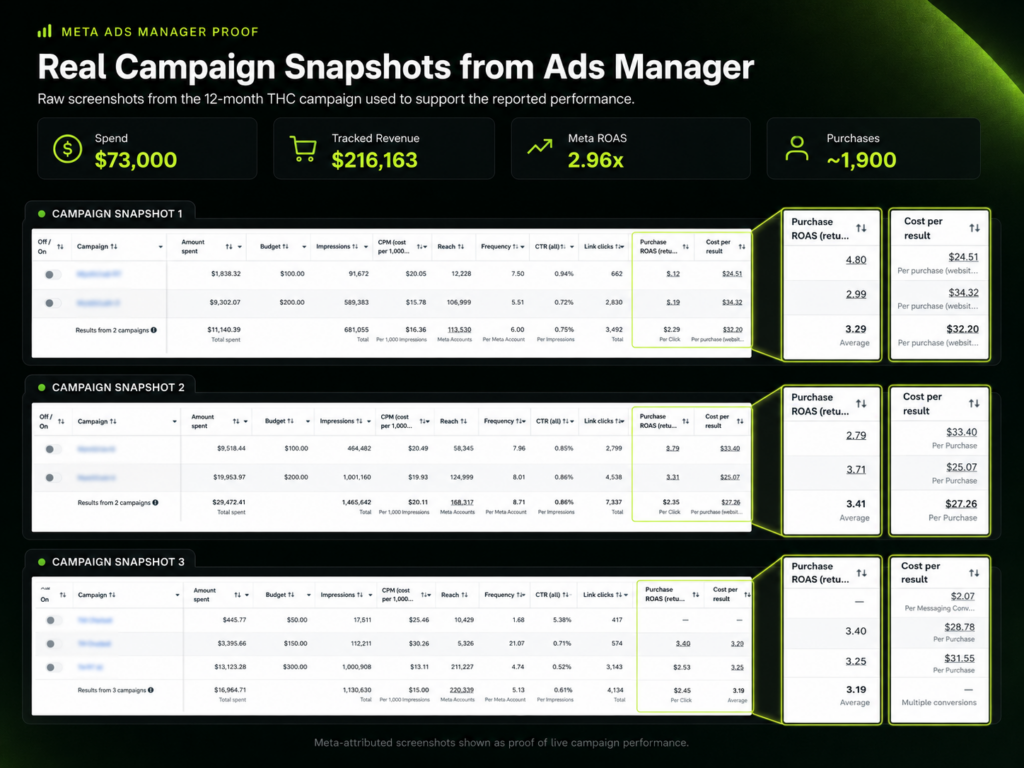
Over 12 months, the campaign generated:
- $73,000 in ad spend
- $216,163 in Meta-attributed revenue
- 2.96x Meta-attributed ROAS
- ~1,900 purchases
- ~$38 average cost per purchase
The best month was January 2026, where the campaign generated:
- $6,777 in spend
- $29,230 in revenue
- 4.3x ROAS
This was a major improvement from the client’s previous performance of around 1.4x ROAS before we took over.
And since Meta underreported revenue for part of the campaign, the true backend revenue was likely at least 20% higher than the numbers shown inside Meta.
What Made the Campaign Work
The campaign worked because we did not treat it like a normal e-commerce account.
A THC brand needs more than basic campaign setup. It needs careful positioning, consistent creative testing, accurate tracking, account stability, and daily monitoring.
The main factors behind the result were:
1. Purchase-focused campaign structure
We optimized for sales from the start instead of chasing cheap clicks or low-quality traffic.
2. Consistent creative testing
Testing 100+ creatives gave us enough data to find multiple winning angles.
3. Controlled messaging
The creatives were designed to sell the product while staying careful enough for a restricted ad environment.
4. Broad + retargeting structure
Cold traffic helped scale acquisition, while retargeting helped recover users who needed more touchpoints before buying.
5. Tracking improvements
Even with some underreporting, better tracking helped us make stronger optimization decisions.
6. Full-stack management
We handled the campaign end to end: creatives, copy, media buying, tracking, ad accounts, optimization, and troubleshooting.
7. Stability over time
The campaign ran for 12 months, not just a short burst. That matters in a restricted niche where many advertisers struggle to keep campaigns live consistently.
Key Takeaway
The biggest lesson from this campaign is simple:
THC brands can generate profitable revenue from Meta, but they cannot run it like a normal e-commerce campaign.
The product, offer, creatives, tracking, ad accounts, and optimization process all need to be handled with the restrictions of the niche in mind.
In this case, the client came in with campaigns averaging around 1.4x ROAS. After taking over the full advertising operation, we helped scale the brand to $216,163 in Meta-attributed revenue, 2.96x ROAS, and a best month of 4.3x ROAS.
And because Meta underreported revenue for part of the campaign, the actual backend revenue was likely even higher.
Final Summary
This campaign shows what is possible when a restricted-category brand has the right Meta advertising system behind it.
For this U.S. THC store, we handled the full ad operation across strategy, creatives, campaign management, tracking, account stability, and daily optimization.
The result:
$73,000 spent. $216,163 tracked revenue. 2.96x Meta-attributed ROAS. 12 months of campaign stability in one of the hardest categories to advertise.
For THC, CBD, and other restricted e-commerce brands, the opportunity is there — but the execution has to be built for the niche from day one.
Ready to See Results Like These?
Let us build a campaign strategy tailored to your restricted niche.