How We Generated 6x ROAS for a U.S. Prescription Anxiety Relief Brand Using Meta Ads
A 30-day case study on scaling sales in a restricted pharma category using static creatives, problem-solution messaging, and rapid campaign rebuilding.
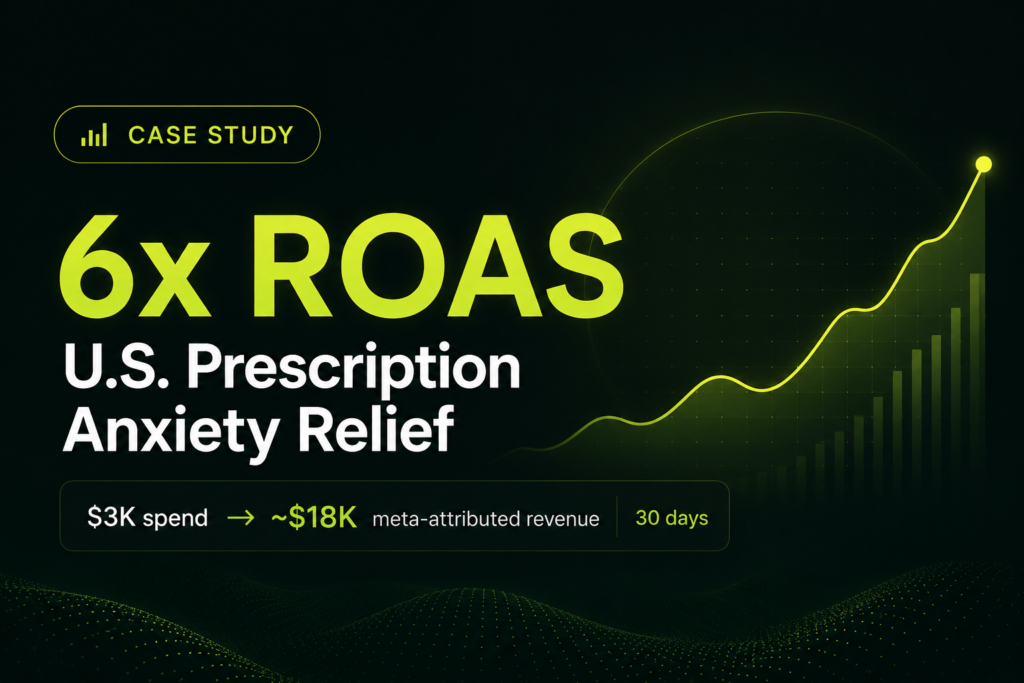
Campaign Snapshot
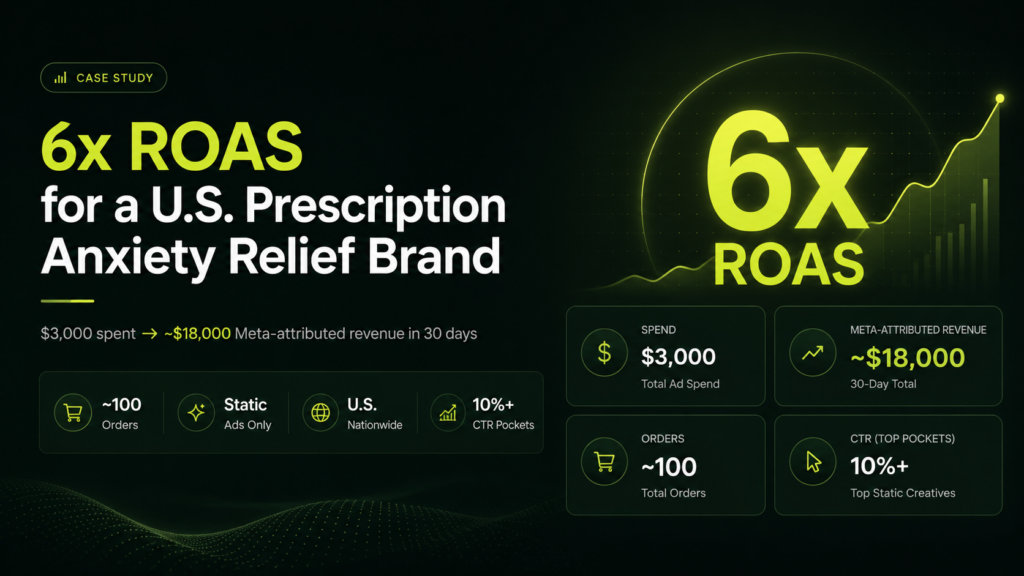
A U.S.-based prescription anxiety relief brand came to us with a new website, no active Meta campaigns, and no previous paid social momentum.
The goal was simple: generate sales through Meta ads.
The challenge was not simple.
This was a prescription-based anxiety relief product in a restricted pharma category, targeting users nationwide in the United States. That meant higher compliance sensitivity, stricter ad review pressure, limited messaging flexibility, and constant account stability issues.
Despite those limitations, the campaign generated:
Ad Spend: ~$3,000
Meta-Attributed Revenue: ~$18,000
ROAS: 6x
Orders: ~100
Estimated CPA: ~$30/order
Estimated AOV: ~$180
Timeframe: 30 days
Market: United States, nationwide
Creative Type: Static ads
Funnel: Meta ad → product landing page
CTR: Several campaigns above 10%
The Starting Point
The client had not been running Meta ads before this campaign.
There was no existing campaign history to build from, no proven ad account data, and no previous Meta learning to rely on. On top of that, the website was new, meaning the funnel had not been battle-tested with paid traffic yet.
That made the campaign more difficult for three reasons:
First, the account had no meaningful performance history. We had to start from zero.
Second, the product category was sensitive. Prescription anxiety relief requires careful ad positioning because aggressive medical claims, fear-based messaging, or direct health promises can create approval issues.
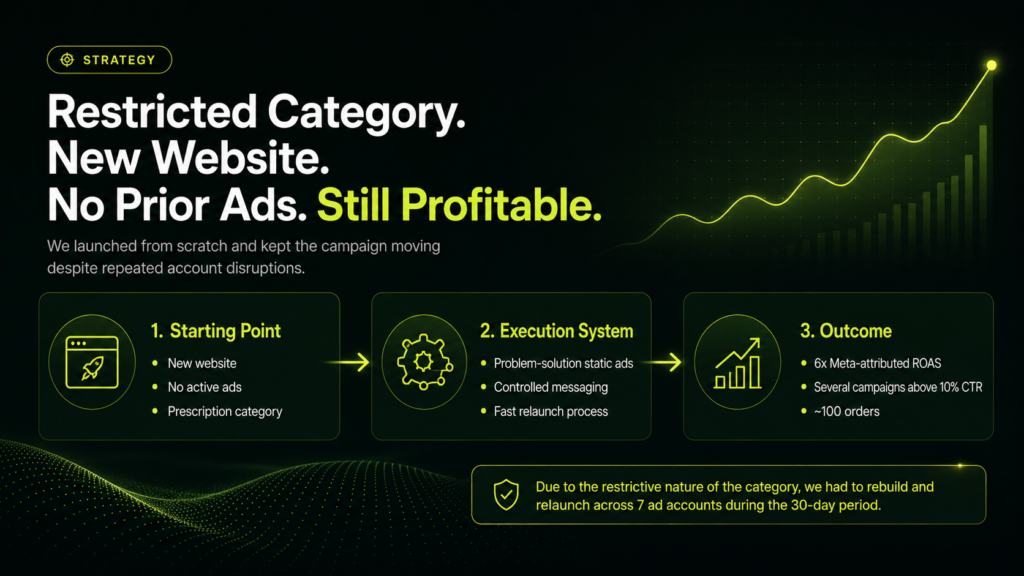
Third, account stability became a major bottleneck. Due to the restrictive nature of the category, we had to rebuild and relaunch across 7 ad accounts during the 30-day period.
This meant the campaign could not depend on a smooth, uninterrupted learning phase. Every time an account was disrupted, we had to move quickly, rebuild the structure, relaunch the best-performing creatives, and keep performance from dropping.
The Challenge
Running Meta ads for a prescription anxiety relief product is very different from running ads for a normal e-commerce product.
You cannot rely on exaggerated claims.
You cannot push aggressive fear-based messaging.
You cannot make the ads feel too medical or too direct.
And even when the ads are carefully written, the category itself can still trigger account and review issues.
The main challenge was to create ads that were strong enough to sell, but controlled enough to survive.
The campaign had to do three things at once:
- Generate sales quickly from a new website.
- Keep CTR high enough to offset expensive U.S. traffic.
- Maintain campaign momentum despite repeated account interruptions.
That combination made this a difficult campaign — but also a strong test of the system.
Our Strategy
We managed the full ad side of the campaign, including strategy, campaign setup, media buying, creative direction, ad copy, testing, optimization, and relaunches.
The landing page was handled separately by the client, so our role was focused on building and managing the Meta acquisition engine.
The strategy was built around four key principles:
1. Keep the funnel direct
We used a simple funnel:
Meta ad → product landing page
There was no complicated pre-sell flow, quiz, advertorial, or multi-step funnel.
For this campaign, the goal was to validate whether direct-response static ads could generate profitable sales directly from Meta traffic.
This also allowed us to judge creative performance clearly. If an ad produced strong CTR, efficient CPC, and profitable sales, we could scale it without overcomplicating attribution.
2. Use problem-solution messaging
The best-performing ads followed a simple problem-solution structure.
The ads focused on the user’s anxiety-related frustration, then positioned the product as a possible solution through a clean, direct message.
The key was to avoid making the ads feel overly clinical or exaggerated.
Instead of relying on hard medical claims, the messaging was built around:
- Relatable anxiety-related pain points
- Simple product positioning
- Clear benefit-led hooks
- Direct but controlled copy
- Clean static creatives
- A straightforward CTA to the product landing page
This gave the ads enough emotional pull to drive clicks, while keeping the messaging more controlled for a sensitive category.
3. Prioritize CTR as the first signal
In this niche, CPMs were high and account stability was difficult.
That made CTR one of the most important early indicators.
If CTR was weak, the campaign would become expensive very quickly. But if we could consistently produce high CTR, we could keep CPC under control even in a competitive U.S. market.
Several campaigns crossed 10% CTR, which was one of the biggest reasons the campaign was able to stay efficient.
High CTR helped create a better traffic cost structure, which then gave the product landing page enough volume to convert profitably.
4. Rebuild fast when accounts went down
Account interruptions were one of the biggest operational challenges.
Due to the restrictive nature of the category, we had to rebuild and relaunch across 7 ad accounts during the 30-day period.
This could have killed performance if the campaign was dependent on one account, one structure, or one creative.
Instead, we kept the setup modular.
Winning creatives, campaign structures, and learnings were carried over quickly. When one account became unusable, we could relaunch the strongest assets and continue pushing traffic.
That ability to recover quickly was critical.
The campaign did not win because everything ran smoothly. It won because we were able to keep rebuilding without losing the core performance signals.
Creative Approach
All creatives used for this campaign were static.
This is important because many advertisers assume they need complex video funnels or UGC-style production to make difficult niches work.
In this case, static creatives were enough because the messaging was clear and the problem-solution angle was strong.
The ads were designed to do three things quickly:
- Capture attention with a relatable anxiety-related hook.
- Present the product as a direct solution.
- Push the user to the product landing page.
The creative did not need to be overly polished. It needed to be clear, relevant, and easy to understand within seconds.
That is what helped drive multiple campaigns above 10% CTR.
Results
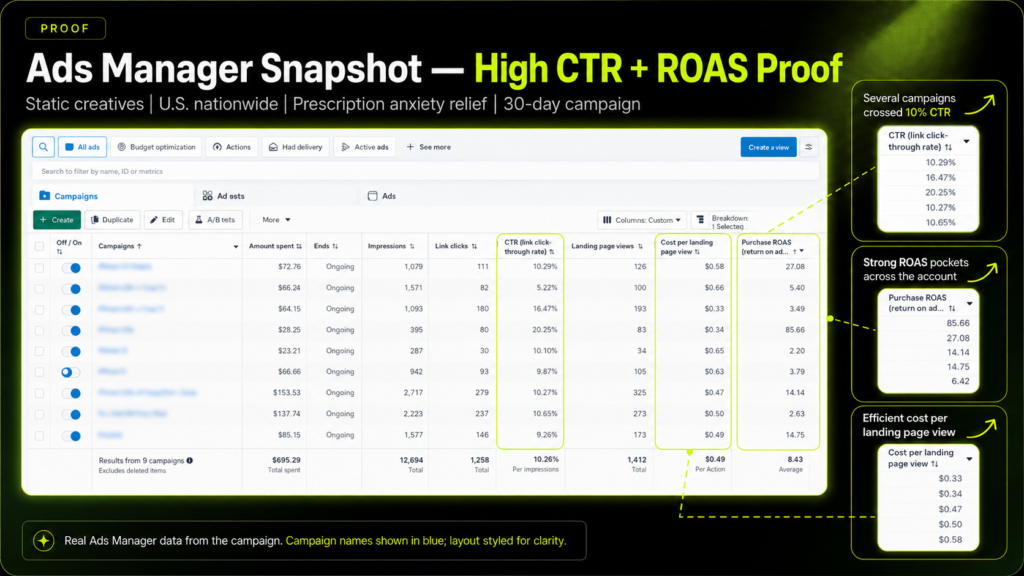
Over the 30-day period, the campaign generated approximately $18,000 in Meta-attributed revenue from around $3,000 in ad spend.
That worked out to a 6x Meta-attributed ROAS.
The campaign also generated approximately 100 orders, with an estimated CPA of around $30 per order.
For a new website in a prescription anxiety relief category, this was a strong result — especially considering the campaign had to deal with repeated account disruptions throughout the month.
Final numbers:
Spend: ~$3,000
Revenue: ~$18,000 Meta-attributed
ROAS: 6x
Orders: ~100
CPA: ~$30/order
AOV: ~$180
CTR: Several campaigns above 10%
Ad accounts used/rebuilt: 7
Campaign duration: 30 days
Why This Campaign Worked
The campaign worked because we did not rely on one single factor.
It was not just the offer.
It was not just the copy.
It was not just the targeting.
It was not just the account setup.
The result came from combining multiple things correctly:
- A direct sales objective from day one
- Static creatives built around clear problem-solution messaging
- High CTR hooks that made U.S. traffic more affordable
- Fast testing and optimization
- Controlled messaging for a sensitive prescription category
- Quick relaunches whenever account issues appeared
- A simple funnel that made performance easy to read
The biggest win was not just the 6x ROAS.
The bigger win was proving that even a new website in a restricted prescription category could generate profitable Meta sales when the campaign was structured correctly.
Key Takeaways
This campaign showed that Meta can still work for difficult pharma-adjacent and prescription categories, but only if the campaign is built with the restrictions in mind.
For this type of offer, aggressive ad copy is not the answer.
The better approach is controlled direct response:
- Speak to the problem clearly.
- Avoid exaggerated claims.
- Keep the message simple.
- Test static creatives quickly.
- Watch CTR closely.
- Move fast when accounts become unstable.
- Keep the funnel clean.
In this case, that approach helped generate 6x Meta-attributed ROAS in 30 days, with several campaigns crossing 10% CTR, despite the campaign starting from scratch and requiring relaunches across 7 ad accounts.
Conclusion
A U.S. prescription anxiety relief brand came to us with a new website, no active Meta ads, and no previous campaign momentum.
Within 30 days, we generated approximately $18,000 in Meta-attributed revenue from around $3,000 in ad spend, producing a 6x ROAS and around 100 orders.
The campaign succeeded despite operating in a restricted category, using static creatives only, and dealing with repeated account disruptions.
The biggest lesson from this campaign is simple:
Restricted niches are harder, but they are not impossible.
With the right creative angle, controlled messaging, strong campaign management, and the ability to rebuild quickly, Meta can still produce profitable sales — even in categories where most advertisers struggle to stay live.
Ready to See Results Like These?
Let us build a campaign strategy tailored to your restricted niche.